

Sandy Darling is a member of the cathedral congregation and author of A Visual Tour of Christ’s Church Cathedral, Hamilton, Ontario. CCC, second, revised edition, September 2025, ($10.00/ $17.00 by mail).
On January 1, 1876, Christ’s Church Hamilton was consecrated as the cathedral of the Diocese of Niagara, which had been established in 1875. The parish of Christ’s Church was established in 1835 by the Reverend John Gamble Geddes, who was sent by the Bishop of Quebec to develop the Church of England in this region. A wooden church, designed by Richard Charles Wetherall, the architect of Dundurn Castle, was subsequently built. It was a large church in the Palladian Baroque style that was 100 feet long and 60 feet wide. People referred to it as “Geddes’ church”, but he insisted that it was Christ’s Church, a name that was then used, unlike the more common “Christ Church”.
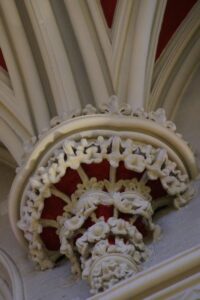
By the early 1850s, the railway came to Hamilton, which was growing into a sizable town at the head of navigation. Richard Thomas, a notable architect from Toronto, was hired to design a larger stone building that included a chancel and a tower that was never built. A shortage of funds meant that only the first two bays and a sixteen-foot chancel could be built by 1855, resulting in what was called the hump-backed church. Thomas then took his plans to St Andrew’s (now St Paul’s) Presbyterian congregation, so one may see the tower that Christ’s Church never had. In the early 1870s, the three western stone bays were added using the designs of Henry Langley, a Toronto architect.
The final stage of building the cathedral we know today was the lengthening of the chancel in 1925 to 48 feet and adding the sacristy and dean’s vestry with organ lofts above. The design was undertaken by William Palmer Witton, a Hamilton architect. Although we glibly talk of “lengthening the chancel”, this involved taking down the east wall and window and rebuilding it so that the window could be as it had been, Although the stone building was completed in three phases, the design is essentially that of William Thomas, because Langley and Witton both followed the style he had set, so the new and old sections are seamless. A reader who wishes to read a more detailed description and analysis of the architecture of the building should read an article by Professor William Thurlby in the Journal of the Society for the Study of Architecture in Canada 42 No. 1, 2017.
Cathedrals have been centres of education and of music and the arts. Cathedral schools were first established in the sixth century for the training of priests and the preservation of knowledge. The universities of Europe grew from them; some of the first were Bologna in the 12th century and Oxford and Cambridge shortly thereafter. Christ’s Church Cathedral today maintains a vigorous educational program. It also has a long choral tradition, and directors of music have established or led many choirs in the city. The building has served as a venue for visiting choirs on North American tours. Both music and art displays are presented during monthly art crawls from May to October and at Supercrawl in September, which together attract 10,000 visitors annually.
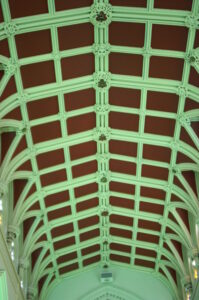
The building itself is a testament to the visual arts. The high ceilings provide space for large stained-glass windows, the earliest of which, dating from 1853, was designed by Ballantine and Allen of Edinburgh. Commercial firms developed in the 1830s to 1850s, just before the growth of Neo-Gothic churches like the cathedral. In Canada, the firm of McCausland was founded in 1857 and designed various windows in the cathedral. Two are notable: the east window, according to the newspaper report of its dedication, was the largest stained-glass window made in Canada, and the Annunciation window appeared in the Colonial and Indian Exhibition in London in 1885. There are six different manufacturers of windows, with over one hundred years between the oldest and youngest windows, so there is a great variety in styles. Most of the woodwork was carved by Valley City Manufacturing of Dundas, a leading firm in Canada. The splendid limestone reredos was carved in England by the leading supplier of ecclesiastical fixtures and supplies.
The role of the cathedral in the diocese owes much to Bishop Ralph Spence, who saw the cathedra and the Cathedral as symbols of Anglican unity. He moved all confirmations, conferring of the Order of Niagara, ordinations and installations to the Cathedral. The associated services bring together members of many congregations and provide greater support to candidates.
The Cathedral and its congregation are very different from those my wife and I joined in 1975. It was then a very white, Anglo-Saxon congregation with little connection to the local community. Some of the notable changes were the initiation of a day-care around 1990, the development of Makers’ Market and the opening of the Cathedral to visitors in the first decade of this century, and more recently, the development of the Cathedral Café to minister to those in need. As such initiatives were introduced, the nature of the congregation changed to one that is more diverse and inclusive, and less formal. Rather than being internally focused, the Cathedral and its congregation look outward to serve and welcome others.
Christ’s Church Cathedral is the mother church of the Diocese of Niagara. Bishop Susan Bell and Dean Tim Dobbin invite you to celebrate with us the 150th anniversary of the Cathedral’s consecration at our 10.30 a.m. service on Sunday, February 8, 2026.

The Church in Which We Serve