
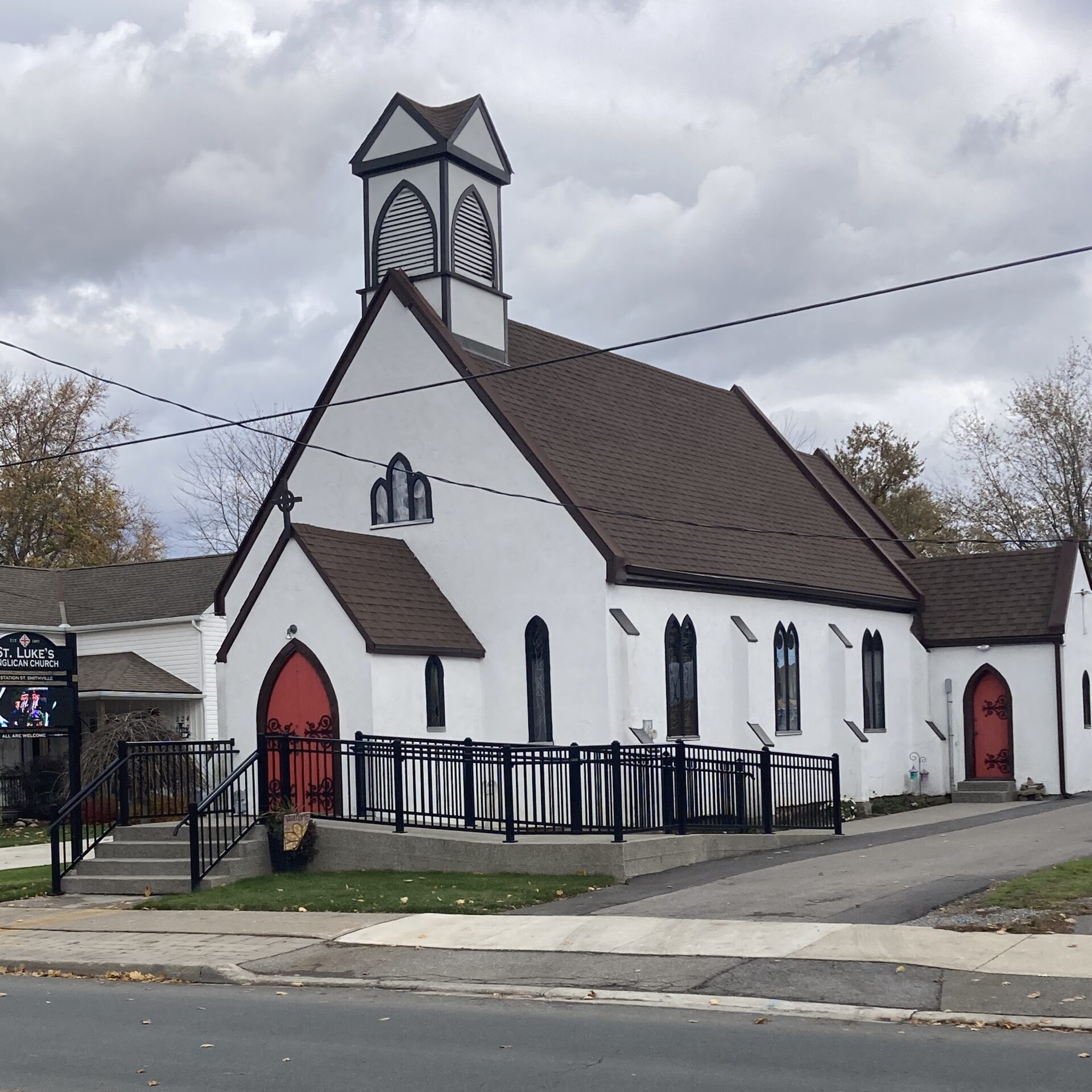
The small, rural church of St. Luke’s, Smithville, Ontario, located in the hub of the Niagara Peninsula, has been actively taking giant steps towards being fully accessible to all people. This target, which was one of the very first Mission Action Plan (MAP) goals fully adopted by the congregation, has recently completed a major step forward. With the generous support of the Anglican Foundation of Canada (AFC), by means of a fifteen-thousand-dollar ($15,000) grant, the front access to the church has undergone a complete upgrade. The Anglican Foundation Grant was generously matched by support from a member of the church’s congregation.
St. Luke’s is an older church, constructed in 1885. At that time, accessibility was not a design or construction consideration. This is shown in the picture of the way the front of the church used to be, with its original three concrete steps. Although three steps don’t sound like a lot, to a person with mobility restrictions, it might as well have been a mountain. For years, members, as they aged and developed problems, struggled to attend the small church that they loved so much. When Bishop Susan Bell, bishop of the Diocese of Niagara, introduced her new focus to the churches by way of The MAP Process, the parishioners of St. Luke’s took this as the impetus they needed to create change.
To accomplish the MAP Program Goal, St. Luke’s divided the task of making all of the church and its facilities fully accessible into ‘bite-sized’ individual areas. Three major areas were identified as needing upgrades. The first area was the front access to the church. The second area was access to the church’s community hall. The third area was the upgrade required for the washrooms. For a small church in a rural community, initially, this overall goal seemed impossible to achieve, but the congregation was determined to see it through.
Eleanor Clitheroe, the parish rector, thoughtfully took the time necessary to lead the members of the parish corporation in multiple discussions on developing the plans and stages necessary to complete the overall project. All design work was designed to meet and exceed the Ontario Accessibility guidelines. St. Luke’s is fortunate to have as part of its leadership Stephen LaSalle, the parish deacon. LaSalle became a valuable asset and sounding board in setting the requirements that needed to be obtained.
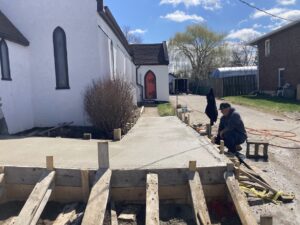
To date, most, but not all, of the accessibility needs of the church have been met. The door to the community hall has been replaced with a widened, automatically activated door along with a small ramp for its threshold. One of the hall restrooms was completely gutted to allow an increase of more than double its overall size. An enlarged automatically operated door was also installed. Inside, the toilet was changed to a raised model, and all the required handbars were installed.
The main entrance to the church proved to be a major undertaking, far greater than was anticipated. Bruce McFarlane, people’s warden, became the lead church member to assess and provide solutions to the various problems that surfaced during the construction. One of the main issues was the underground services to the church. These services became an issue for the concrete work that needed to be done. As luck would have it, the main sewage drain line for the church and the community hall, as well as the hydro feed lines, were buried directly in the path where the new church entrance platform had to go. McFarlane, working hand in hand with the contractors, was able to solve this difficult problem. The new, improved church entrance now includes an expanded front deck, stairway and a mobility ramp along with all the required handrails.
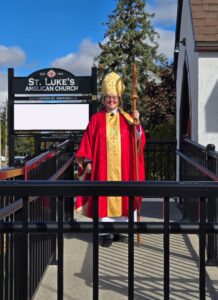
Although a lot of work has been undertaken and accomplished, there is still more to do. Planning and discussions are ongoing regarding the changes required to make the inside of the church fully accessible to people with mobility impairments. The main body of the church was built in multiple levels, which results in difficulties for some members to come to the altar and to transfer from the church to the community hall. The goal of having the church all on one level is ambitious. Being well over 125 years old, the foundations and wall structures require a great deal of planning and design before they can be modified. But, St. Luke’s is determined that ALL people, no matter who they are or where they are on life’s journey, are welcome here, and accessibility is one of the steps making that happen.

Video Killed the Radio Star