
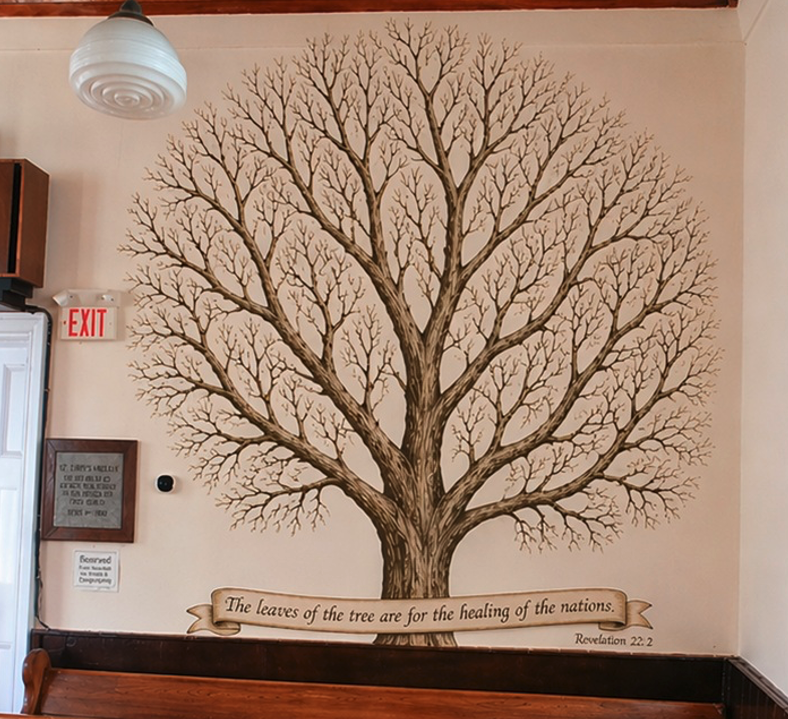
At St John’s, Burlington, we are planning to paint a large, leafless maple tree on the back wall of the nave. At first hearing, that may not sound like the most obvious way to brighten a church. Most parishes, after all, spend considerable effort avoiding bare branches and unfinished work. Yet that is precisely the point. The tree will begin empty, but it will not remain that way. Rising approximately fourteen feet above the existing wooden panelling, its branches will gradually receive individual wooden maple leaves, each bearing the name of a member of St John’s. There will eventually be space for about two hundred. What begins as a bare outline will slowly fill out, becoming a visible expression of a living and growing community.
The idea grew from a simple conviction: a church is not merely a building people attend, but a living community in which names, lives, gifts, and stories become part of something larger than themselves. We use the word “belonging” often in church life, and rightly so, but belonging can remain abstract. A name on a leaf makes it visible.
No single leaf makes a tree, yet every leaf changes it. Each one represents a person whose prayers, presence, service, humour, grief, generosity, and faith have become part of the shared life of the parish. The tree is not intended primarily as a memorial. It is a celebration of the people whom God has gathered here now, though there may occasionally be leaves added in memory of loved ones.
Beneath the tree will be the words from Revelation 22:2: “The leaves of the tree are for the healing of the nations.” Revelation ends not with humanity escaping the world, but with God renewing it. A river of life flows through the holy city, the tree of life bears fruit, and its leaves bring healing. It is one of scripture’s great visions of restoration: creation made whole, divisions overcome, and God dwelling among God’s people. That matters because the names on our leaves are not simply declarations that we belong to St John’s. They are also reminders that belonging has a purpose. The Church is gathered in order to be sent. We are called not only to enjoy community, but to become part of God’s healing work in the world: through worship, service, welcome, forgiveness, justice, and care.
Naturally, turning the vision into reality has been slightly less straightforward than imagining it. Two artists who had hoped to paint the tree have had to withdraw. One, quite reasonably, was nervous about working at height. Our first challenge has therefore been finding an artist who shares the vision and is also on speaking terms with a scaffold. There is something rather appropriate about this. The tree is meant to speak of growth, and growth is rarely neat. Parish life develops through trial, patience, changed plans, and the willingness to begin again. The work of God is often less like unveiling a finished masterpiece and more like tending something whose final shape we cannot yet see.
That may be especially important for churches today. Across our Diocese, parishes live with very real concerns about attendance, finances, buildings, volunteers, and the future. We measure carefully, and we must. Budgets and statistics matter. But they do not tell the whole story. A parish cannot be fully described by a spreadsheet. Behind every number is a name, and behind every name is a life: someone who has found friendship, offered prayer, carried grief, served quietly, discovered faith, or helped another person feel less alone. There are conversations over coffee, meals delivered, children welcomed, funerals shared, questions explored, and small kindnesses that will never appear in an annual report. The tree will not solve the practical challenges of church life, but it may help us see that life more truthfully.
St John’s is still growing. Not always quickly, not always predictably, and certainly not without setbacks, but growing nonetheless. New people arrive. Existing members discover new gifts. Relationships deepen. The community changes. The branches make room.
For now, the tree exists chiefly in imagination. Its branches are bare, its leaves have not yet been cut, and the right artist has still to be found. Perhaps that too is fitting. The Church is always unfinished. God is still adding names, unfolding gifts, and bringing life where bare branches once seemed to be the whole story. Over the years, we hope our Revelation tree will grow not only in leaves, but in meaning. And perhaps it will remind everyone who enters that we have been gathered not simply to belong to one another but, by God’s grace, to become part of the healing of the nations.
The Church in Which We Serve