
The queer and trans people in my circle of friends will tell you it feels like things are getting worse right now, not better.
I’m sure your media feeds are like ours, flooded with loud conservative political and religious voices repeating messages about traditional values, safety and security, and free speech. Especially when these loud voices are amplifying inaccurate or fabricated information about trans athletes, or healthcare for trans youth, they are creating a permission structure for pundits and politicians to chip away at the fundamental rights of queer and trans people.
This isn’t happening only in the United States. On December 10, 2025, the Government of Alberta invoked the notwithstanding clause to shield three of its laws from court challenges. Those three laws police the names and pronouns children and youth are allowed to use at school, ban transgender girls from participating in amateur sport, and deny medically-necessary healthcare for trans and gender diverse youth.
Yes, it feels like things are getting worse right now, not better.
There are no simple solutions to the complex problems we’re facing in 2026. But the politics of division isn’t working. The way of exclusion and violence is unacceptable.
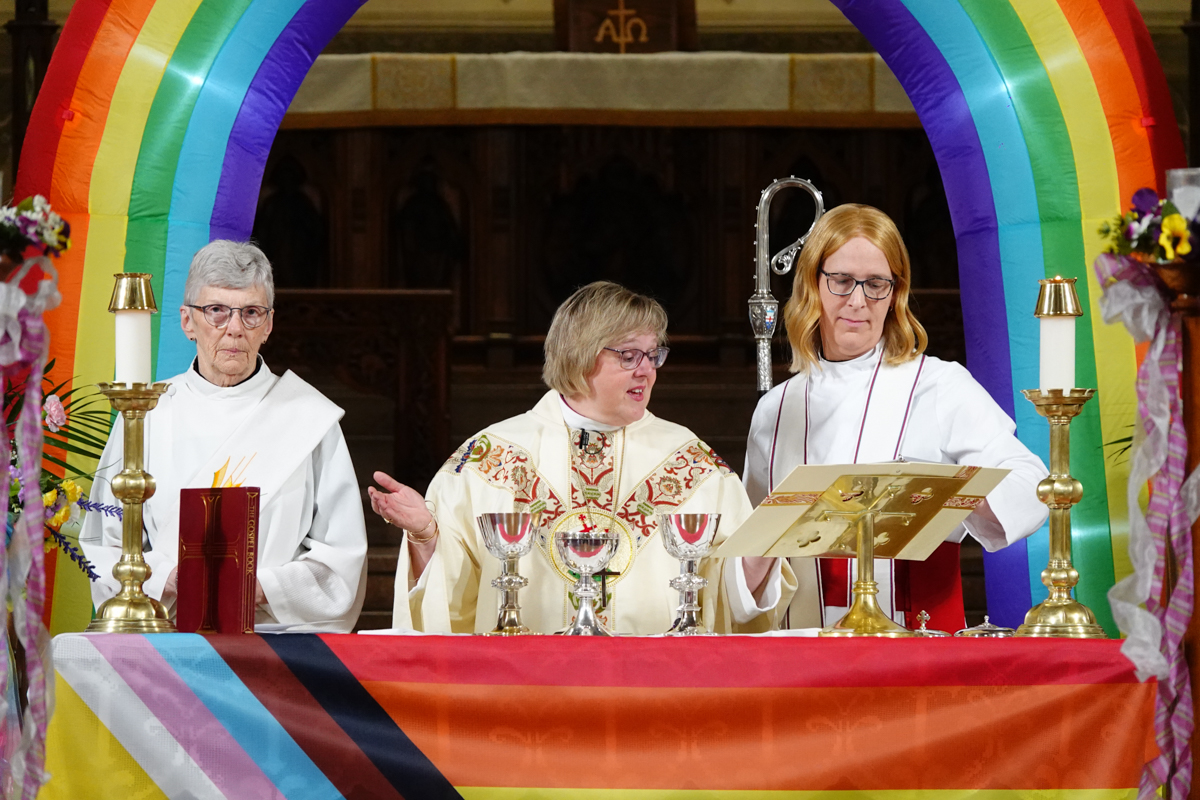
The current social and political landscape has been front of mind for the team’s planning for this year’s diocesan Pride Mass. We see the consequences of the permission structure created by those divisive voices in our media feeds. We hear our queer and trans friends expressing their longing for a community that is responsive to the cries for justice arising all around us. Quite simply, we want to know that God hasn’t forgotten us.
The planning team chose Jesus’ words, “this is my body,” as the theme for our Pride celebration this year. “This is my body,” will be familiar to Anglicans because these words form one of the high points in the Eucharistic Prayers, which we hear when we attend church week by week. Without losing the connection to the Eucharist, the team also takes a page from Paul, who thinks about the church as a body with many parts with Christ as its head (1 Corinthians 12.12-27). So, those gathering at this year’s Fiercely Loved, allies and 2S&LGBTQIA+ people together, we will all hear a proclamation where Jesus says of us, “This is my body.” Or possibly, “You are my body.”
By God’s grace, we embody Christ’s presence in the world. For me, and hopefully for all of us, this is a source of hope in light of our current social and political landscape. Because loud conservative political and religious voices are going to say all kinds of things about queer and trans people in their media feeds, but none of the things they say can dilute the grace that enables me, enables us, to embody Christ’s presence in the world.
At this year’s diocesan Pride Mass, we will celebrate the ways all of us living in diverse and different bodies, some of us living in queer bodies, are empowered by God’s grace to join God’s work in the world.
This just may be the church’s super-power, where members of a genuinely diverse community each find their place in a common mission. Because all of us are called to take part in shaping resilient, inclusive communities that embody God’s reordered new society (the Gospels call this new order the Kingdom of God), which Jesus begins raising up through his life and teaching.
I hope I’ll see you at the Pride celebration we’re calling “Fiercely Loved: This Is My Body.” We gather in person at Christ’s Church Cathedral and on the diocesan livestreams on June 7th at 4:00 pm.
The Church in Which We Serve